
To make a track that players will enjoy, it is important to take gameplay into consideration. You don’t want to discover that there is a layout issue after you’ve spent a lot of time making the road’s surroundings pretty!
Gameplay is important to consider during many steps of the track-making process: when designing the track, when modeling it, when testing it, when placing decorations, etc.
The best tracks of course combine beauty and gameplay, but players will more easily tolerate tracks with simpler graphics than tracks that leave them bored or confused.
This page covers fundamental concepts that are important for every track.
How well a track follow these gameplay guidelines also plays a role when determining if it should be showcased in the addons explorer.
Contents
- Key principles
- Road visibility and clarity
- Road width
- Curves and straights
- Match visuals and gameplay
- Length
- Minimap clarity
- Marking the lapline
Key principles
To obtain the best results, it is strongly advised that you read the detailed sections and try to incorporate their advice in your work. However, if you are new to track-making, you may want to get started without getting into all the details.
So here are the most important principles for your track’s gameplay to be fun:
- The player should clearly see where the road (as opposed to off-road) is and where the road goes next. The access to alternative paths may be concealed.
- Don’t make the track too narrow, especially around the start line. Races with up to 20 karts should still be playable.
- Ensure there are some difficult curves as well as some easier sections where it’s relatively safe to use speed boosts.
- Use visuals to communicate hints about gameplay (such as using grass or sand terrain to communicate an off-road area) and avoid misleading players with fake or missing cues (such as invisible walls and dead ends).
- The ideal length of a track is between 40s and 70s driving at SuperTux speeds without nitro and drifts. However, shorter tracks are a good way to learn for your first few tracks.
- Try to keep the minimap clear.
- You can use some zipper pads, but there should be several track sections without them.
- Alternative paths can be fun, but if you choose to use them, you have to ensure they are reasonably balanced:
- If a path is slower, it should be easier.
- The time difference between paths should be moderate, ideally less than 1 second, no more than 2.
- Jumps are a fun element so you can place some, but provide proper landing space after the jump, and, if your jump is mandatory, that it doesn’t prevent completing the track for newbies driving at slow speeds.
- Dynamic obstacles are great if you can add them, however the player should be able to see them and avoid losing much time if he reacts properly.
- Place a reasonable amount of gift boxes and some bananas.
- Avoid placing too much nitro, especially big nitro cans. This is a common trap for new track-maker. If a kart can collect more nitro than it can use, it removes a lot of strategy and there is less value in being accurate to collect it.
- It should be very difficult if not impossible to accidentally miss checklines. Few things are as disappointing to a player than seeing their lap not count.
- There should be enough well-placed checklines to prevent exploits skipping part of the track.
The more detailed sections on this page as well as on the Advanced gameplay design, Placing items, and Drivelines and Checklines pages cover all these points (and more!) with explanations, practical advice and examples.
Road visibility and clarity
This is perhaps the most important gameplay rule of all. While you can hide alternate secret paths, it is imperative that the player sees clearly where the road is and where it goes next.
This is not negotiable, a track where the road is difficult to distinguish from the off-road will confuse and frustrate players discovering the track for the first time, and depending on how severe the issue is, it will also aggravate players that have driven it many times before. Tracks where there is a vast area without clear indications on the correct direction to follow are likewise problematic.

This room in the original STK Enterprise track often confuses new players who lose time trying to figure out where to go.
There are a few simple methods to get a good result here:
- Have contrasting colors between the road the player should follow and the surrounding off-road areas. This is the easiest and most important method to tell your players where to go next.
- Try to keep the inside of curves free from obstacles, to allow players to anticipate what’s coming, unless there is a strong thematic reason to do otherwise.
- If, for thematic reasons, your track features areas that look like the main road that shouldn’t be driven on, block them off. Dead-ends that lure the players by looking like normal road are not acceptable on a major path (it may be used in secret alternative paths).
- If you have elevation changes, avoid strong concave curvatures (curving inwards like the exterior of a ball), as they prevent seeing what lay behind.
- Small convex curvatures (curving outwards like the interior of a ball) on the other hand improves visibility of what lays ahead. This can be used purposefully to help the player see what’s coming (such as difficult curves).
- It is possible to make use of item placement to emphasize where the road goes, but this should only be a small bonus, never the main indicator. The road should be clear even without items.
- Misleading nitro cans and gift boxes that lure players into a trap should be avoided (it is fine if they merely lure players on a suboptimal trajectory or path). Leave complicated puzzles for egg-hunt mode.
- If poor visibility is unavoidable in a specific spot, keep the road that follows relatively simple and predictable. The general rule of thumb is that the more surprising or complex the road layout or the obstacle to come, the higher visibility and clarity should be.
- In particular, avoid placing obstacles that cannot be seen before you are about to drive into them. This applies doubly for anything dynamic that changes lap to lap.
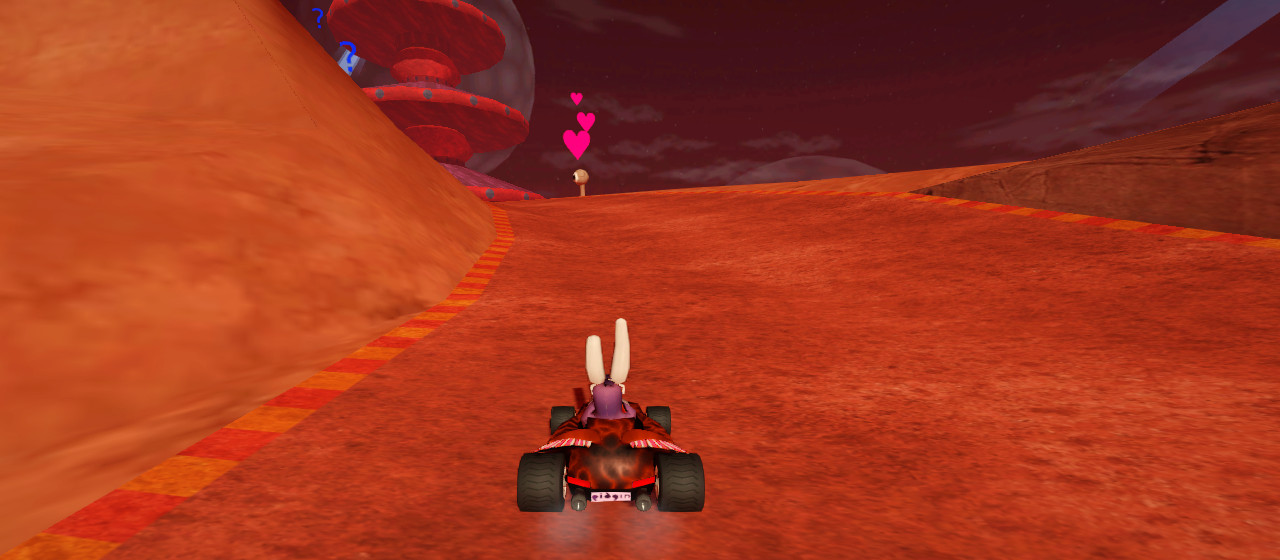
XR591 gives here an example of what not to do: poor color contrast, inconsistent curvature and obstacle on the inside of the curve make this place confusing and frustrating for new players.
If your track features an alternative path, it is fine if the access to the alternative path itself is concealed, such as for example the bridge in Grand Paradiso Island. But once a player has entered an alternative path, the same general rules as for the main path apply.
Road width
In most cases, you should avoid making the track too narrow—when playing with lots of AI karts especially, this will result in a lot of frustrating collisions between karts.
This section will be expanded at a later point.
Curves and straights
Designing a fun and satisfying series of bends and straights is one of the most fundamental and essential challenges in track-making.
Mastering SuperTuxKart’s driving mechanics and playing on a variety of tracks brings an amount of experience that’s difficult to distill in words. Nonetheless, some general guiding principles can go a long way.
To a large degree, it is a matter of balance:
- A track with only tricky sections will be tiring for players and risk being unapproachable for less experimented players. Furthermore, powerups such as zippers and other speed boosts can be very difficult or impossible to use safely without some easier sections.
- On the other hand, a track with too many easy curves and straights is simply boring, as it’s too easy.
The balance you choose between the type of sections is an important factor in the final difficulty of the track. Alternative paths, discussed on the advanced gameplay design page, can be a good way to make tracks enjoyable for a wider range of skills.
But there is more to good curve placement than how difficult you make them and how often you place them.
This section will be expanded at a later point.
One curve prepares the next one
This section will be expanded at a later point.
How drifts affect good curve design
This section will be expanded at a later point.
Match visuals and gameplay
Just as the road should be clear and visible, it is important that the visual cues you give to the player are consistent.
Invisible walls are terrible.
This section will be expanded at a later point.
Length
There is an element of subjectivity when discussing the ideal length for a track, and depending on your track concept you may prefer a shorter or a longer track.
However, there are some general downsides to short and long tracks to keep in mind:
- If a track is too short, you are limited in the variety of gameplay elements. To get a reasonable race duration, you need a higher default lap number. This introduces issues with players lapping each other and may feel repetitive. Oliver’s Maths Class suffers from these problems although its difficulty offers some mitigation.
- If a track is too long, the difficulty lies in sustaining high quality sections and good race length. It is possible to ensure high-quality gameplay throughout, but this means a lot of work, and instead of being enjoyed 3 or 4 times during a race, your highest quality elements will only be enjoyed twice or even once. Adding or removing one lap changes the race length a lot with a long track, making it difficult to fall into the sweetspot length. Furthermore, interactive elements such as gums left on the ground lose importance with a smaller lap number.
There are different methods to measure track length, but a good method is to check how much time it takes to complete a relatively clean lap at SuperTux speeds, without using nitro, drifts, or powerups. That way, you don’t need to be an excellent driver to get useful data.
Using this method, with a heavy kart in 1.5 or a medium kart with STK Evolution balance, a good length is between 40s and 70s, with a sweet-spot around 60s. For reference, as I wrote this guide I got 42s in 1.5’s Northern Resort and 77s on 1.5’s Volcan Island, so you may want to adjust the suggested times if you happen to drive at a different pace.
When designing your first few tracks, it is fine to make shorter tracks because it is much easier to complete a smaller project, and the lessons learned from those early tracks will help you make better ones afterwards.
Beyond this exception, it is highly advised that you stay within the recommended limits for track length. It is possible to make a good track outside of them, but it’s more difficult and track length will work against you.
Minimap clarity
This is a minor point, but a clear minimap helps players.
Therefore, when roads on different levels cross each other, it should be in one clear point, rather than on many. This is especially important if you have complicated alternative paths or use sections with inverted gravity.
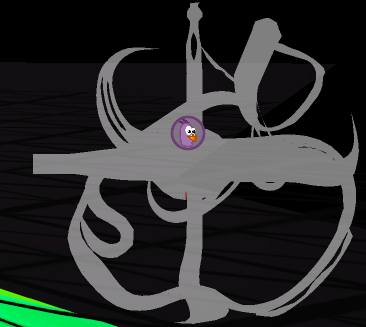
This minimap of Dyson Speedway shows how useless the minimap can become if you disregard it while making a complicated track.
When you have to mark the driveable area later on with drivequads, take care of marking the entirety of the driveable area, instead of leaving out some on the side. This can cause issues with 1.x’s AI karts, but it’s best practice going forward.
Finally, the initial orientation you choose for your road will determine the minimap orientation, so it’s worth to stop and think what will give the best result before committing one way or another.
Marking the lapline
If a lapline isn’t visually indicated, players may be unsure where precisely it is located. Although this might seem a minor point, this can be genuinely annoying for players and it’s easy to take care of.
There are two usual methods to mark the lapline:
- An archway around the lapline. There are many possible visual styles, choose something that looks like it belongs with the rest of your track.
- Markings on the road (often black-and-white checkered markings like on real race tracks).
The archway is often more visible at a distance, but road markings are more precise, especially if the archway is large. You can use either of them, and both methods can also be combined.

Black Forest’s start line uses both an archway and checkered road markings.